
What is Hydrocephalus?
We decided to make a little post about the most common diagnoses of children at the Clinic. This our first post like this.
What is hydrocephalus?
Hydrocephalus comes from two Greek words: hydro-, meaning “water”, and kephalos, meaning “head”. It was once informally called “Water on the brain”. It is a medical condition in which there is abnormal accumulation of cerebrospinal fluid (CSF) in the brain. Normally, there is 120-150 ml of CSF circulating in each person’s central nervous system.
Cerebrospinal fluid (CSF) is a clear, colorless body fluid that is found in the brain and spine and has three main functions:
- Protection: It acts as a cushion or buffer for the brain’s cortex, providing basic mechanical and immunological protection to the brain inside the skull;
- Delivering nutrients and clearing waste;
- Serves a vital function in cerebral autoregulation of cerebral blood flow;
Balance between the production and absorption of CSF is critically important. CSF is produced continuously, about 500-600ml per day, which is the amount that should also be absorbed daily. Abnormalities in the processes of production, circulation or resorption leads to excessive accumulation of spinal fluid and expansion of the space in the brain called ventricles. This expansion causes a potentially dangerous pressure on the brain tissue — hydrocephalus.
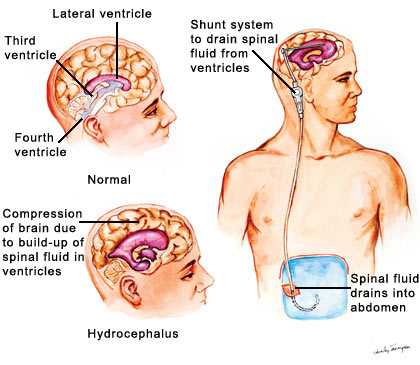
Ventricular system is a set of four cavities interconnected by narrow paths. CFS flows through the ventricles into the cisterns (closed space that works as a reservoir) at the base of the brain, cleans the surface of the brain and spinal cord, and is then absorbed into the blood flow.

What causes hydrocephalus?
The cause of hydrocephalus is not known with certainty. It can occur as a result of inherited genetic abnormalities (such as the genetic defect that causes aqueduct atresia and stenosis) or developmental disorders (associated with neural tube defects, including spina bifida and hernia) . Other possible causes include complications after premature birth (such as intraventricular matrix hemorrhages), infections, brain tumors, head trauma or subarachnoid hemorrhage, blocking normal drainage of the spinal fluid.
What are the types of hydrocephalus?
Hydrocephalus can be congenital or acquired.
Congenital hydrocephalus usually occurs during the fetal intrauterine development due to infection, hypoxia, genetic abnormality (aqueduct atresia and stenosis, Dandy-Walker syndrome, Arnold-Chiari malformation and others), or underdevelopment of the structures involved in spinal fluid resorption.
Acquired hydrocephalus can occur at any age as a result of trauma or disease.
Hydrocephalus can also be communicating and non-communicating (obstructive), based on its underlying mechanisms.
Communicating hydrocephalus (also known as non-obstructive) is caused by impaired cerebrospinal fluid reabsorption in the absence of any CSF-flow obstruction between the ventricles and subarachnoid space.
Non-communicating (obstructive) hydrocephalus is caused by a CSF-flow obstruction. It can be either congenital or acquired. Acquired form occurs due to tumors, most commonly in the fourth ventricle. Congenital form occurs due to:
- stenosis of the aqueduct, caused by an obstruction of the aqueduct of Sylvius (a small path between the third and fourth ventricles); in case of congenital stenosis small size of posterior fossa is not uncommon;
- Dandy-Walker malformation, characterized by the obstruction of the foramina of Luschka and foramen of Magendie;
- benign intracranial cysts (arachnoid and ependymal) hydrocephalus linked with x-chromosome is a very rare form of congenital hydrocephalus and can only be found in males.
Functional, hypersecretory hydrocephalus is caused by overproduction of CSF (Choroid plexus papilloma). This tumor itself can block the ventricular system, leading to the development of non-communicating hydrocephalus. In other cases, minor bleeds from such tumors can lead to the obstruction of subarachnoid space, which is exactly what explains cases of continued hydrocephalus after the tumor has been removed.
There are also two types of hydrocephalus that do not exactly fit into any of the above categories, and mainly relate to adults.
Hydrocephalus ex vacuo refers to the enlargement of the cerebral ventricles due to brain atrophy (decrease in the amount of brain tissue). This condition is not hydrocephalus in its truest form, as the production of CSF equals its absorption. This type hydrocephalus can occur in people of any ages, but is most commonly seen in elderly people. It can occur as a result of subarachnoid space hemorrhaging, stroke, head trauma, infection, tumor or postoperative complications. However, many people develop ‘normal pressure hydrocephalus’ without any of these factors, for unknown reasons
Intracranial pressure (hypertension) in hydrocephalus can keep rising in some cases, or stabilize at some level in other. There are compensated, subcompensated and decompensated forms of hydrocephalus, based on severity.
Treatment methods
Hydrocephalus is most commonly treated surgically, utilizing various types of cerebral shuts. It allows the CSF flow to bypass the obstruction and drain the excess fluid into other body cavities, from where it can be resorbed. Shunts usually consist of a valve housing connected to a catheter (a tube made of silastic). One end of the catheter is placed into the brain ventricles and the other in the peritoneal cavity or the right atrium. The valve maintains a unilateral direction of movement and adjusts the speed of the flow of cerebrospinal fluid. An alternative treatment for obstructive hydrocephalus in selected patients is the endoscopic third ventriculostomy, whereby a surgically created opening in the floor of the third ventricle allows the CSF to flow directly to the basal cisterns, thereby shortcutting any obstruction and allowing CSF to flow to the place of resorption.
What is the probability of a child being born with hydrocephalus?
There is no specific statistics for Ukraine, but it is estimated that two to ten children are born with hydrocephalus for every 1000 newborns.
Prognosis
It is hard to make any prognoses for people with hydrocephalus, although there is some correlation between the cause of hydrocephalus and the outcome. It also depends on the timely diagnosis, extent of the damage to the brain and selected treatment. Both patients and their families need to be aware that hydrocephalus can cause both physical and mental developmental disorders. However, many children with such diagnoses can lead a perfectly normal life, if they had timely surgeries and good rehabilitation. In the absence of treatment progressing form of hydrocephalus leads to death.
Possible complications
Complications can include mechanical malfunctions of the shunting system, infection, blockage, and a need of catheter lengthening or replacement. Shunts require monitoring and regular medical supervision in general.